

Enterprise SEO has always had a different character than small-business SEO. The problems are simultaneously larger and more constrained: more pages to optimize, more stakeholders to align, more legacy technical debt, more organizational friction between the SEO team and the developers who can actually implement changes. Scale amplifies everything — including the consequences of getting it wrong.
Machine learning doesn’t just make enterprise SEO faster. It changes what’s actually possible within the constraints enterprise organizations operate under.
The Core Enterprise Challenge: Signal at Scale
A mid-size enterprise might have 50,000 indexed pages. A large one could have millions. Manual optimization processes, even with large teams, can actively touch a tiny fraction of that inventory at any given time. The vast majority of an enterprise site exists in a state of passive, unmanaged optimization — ranking however it ranks, decaying however it decays, without active attention.
The business consequence of this is significant. Pages that could rank for high-value commercial queries sit at position 12. Category pages with significant traffic potential have structural issues that nobody’s prioritized fixing. High-authority pillar content is underlinked from the internal architecture because nobody mapped it systematically. These are real revenue losses — they just aren’t visible in the way that a broken checkout page is visible.
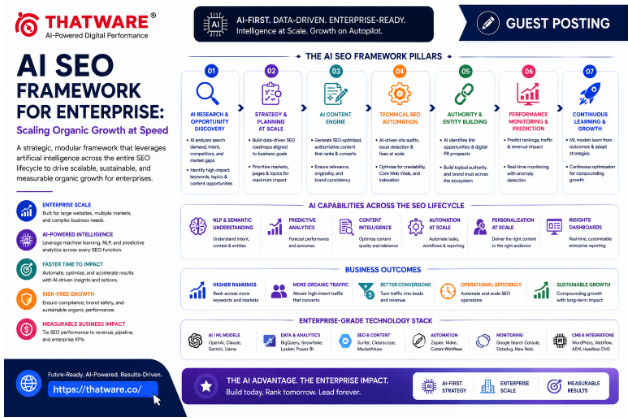
AI SEO framework for enterprise addresses this by making the entire site visible and manageable simultaneously. ML-powered systems monitor all pages continuously, flag issues by predicted revenue impact, identify opportunities across the full content inventory, and prioritize recommendations in a way that human teams can actually act on.
Cross-Department Alignment
One of the underappreciated challenges in enterprise SEO is organizational. The SEO team identifies what needs to change. Development needs to implement technical changes. Content needs to produce new material. Legal needs to approve anything that touches certain topics. Product teams have their own roadmaps.
An AI-driven framework helps navigate this by producing prioritized, business-justified recommendations rather than technical SEO wishlists. When you can say “fixing this crawl architecture issue on these product category pages is projected to produce X% organic traffic increase worth approximately $Y in revenue” — based on ML modeling rather than intuition — development prioritization conversations change character. The work competes on ROI rather than on SEO-team advocacy.
Enterprise AI SEO optimization teams that succeed in large organizations have learned this: the technical intelligence is necessary but not sufficient. The ability to translate that intelligence into business-language justifications is what determines whether recommendations actually get implemented.
Automated Monitoring and Response
At enterprise scale, the number of things that can go wrong simultaneously is genuinely large. Algorithm updates can hit different site sections differently. Migrations can introduce indexation problems. Competitor moves can shift competitive dynamics in specific verticals. Technical deploys can break structured data or introduce crawl barriers.
Manual monitoring can’t catch all of this in time to respond effectively. Automated ML monitoring can flag anomalies — unusual ranking changes, unexpected crawl pattern shifts, sudden changes in impressions or click-through rates — in near-real-time, enabling investigation and response before small problems become large ones.
This monitoring capability is one of the most concrete value propositions of AI-powered enterprise SEO. Prevention is almost always cheaper than recovery.
Scaling Without Scaling Headcount
The traditional answer to enterprise SEO’s complexity problem was more people. More analysts, more content producers, more technical specialists. That approach has limits — both economic and organizational. At some point, headcount creates coordination overhead that undermines the efficiency gains from adding capacity.
AI-powered frameworks scale capability without proportionally scaling headcount. A team of ten with sophisticated ML tooling can manage and improve a site inventory that would previously have required a team of forty doing manual work. The humans focus on strategy, judgment, and implementation; the machines handle the analysis, monitoring, and prioritization at scale.
This changes the ROI math on enterprise SEO investment considerably — and makes the business case for AI-powered approaches much more compelling than the cost comparison at face value might suggest.